85% of Students Use AI: The New Reality of Education
Not long ago, using AI as a student could easily look like cheating.
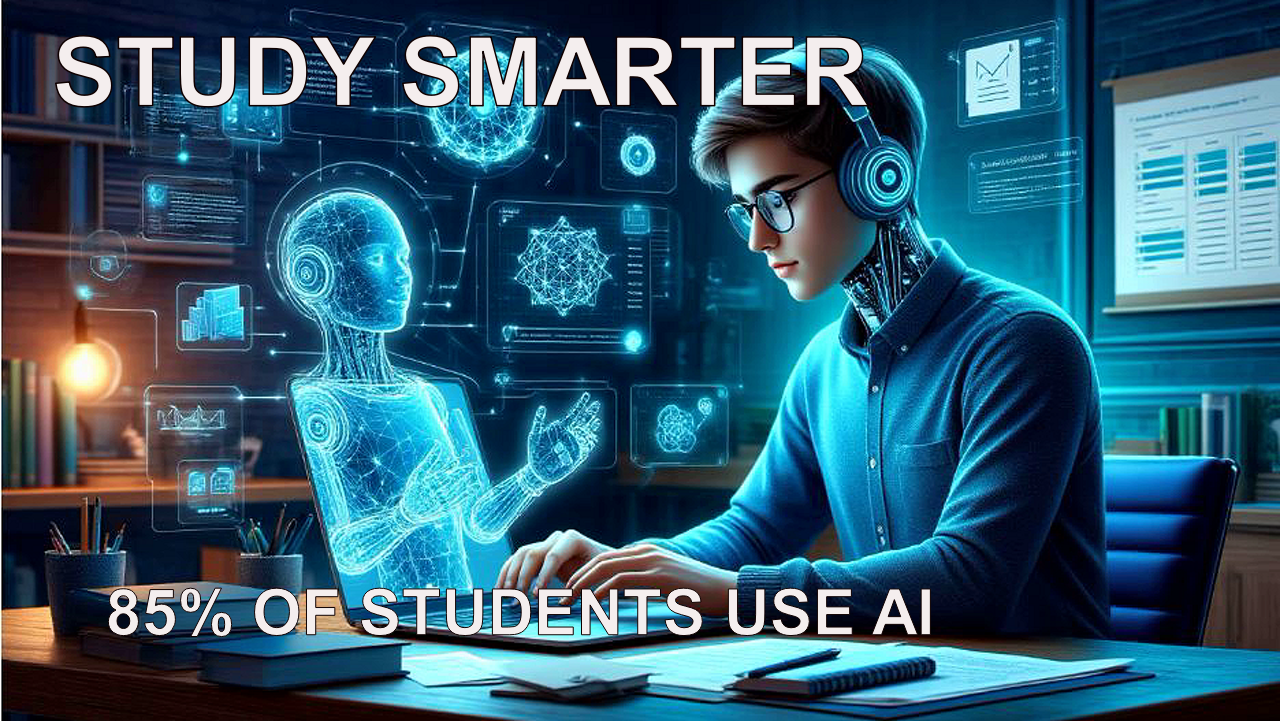
According to a VK Education survey, around 85% of students use AI assistants to improve their study productivity. The survey included more than 1,000 university students aged 18–25.
And this is no longer just an experiment for tech enthusiasts.
AI is becoming a normal part of student life — just like search engines, smartphone notes and online calendars.
But here's the interesting part.
🤖 Students don't have to do everything manually anymore
And your brain contains approximately three useful pages — one of which is currently thinking about why you ever enrolled in university. 😁
In the past, there were basically two options:
pretend you're reading everything.
- explain difficult concepts;
- summarize complex material;
- create self-test questions;
- analyze your mistakes;
- build a study plan;
- generate practice exercises.
And this can be genuinely useful.
🧠 But there's a huge difference between learning WITH AI and learning THROUGH AI
This is probably the most important point.
“Write my 20-page research paper.”
Technically, the task is complete.
A much better approach is to use AI as a personal tutor.
“Explain this topic as if I'm completely new to it. Then ask me five questions and don't show the answers until I try them myself.”
Now AI isn't simply producing the result.
It is making you interact with the material.
That's a completely different use case.
🎓 AI can become a personal tutor
A textbook explains information the same way to everyone.
A teacher can adapt the explanation — but there may be 30 students in the classroom.
AI can adapt the explanation to one person.
“Give me a real-world example.”
“I've already explained this three times.”
⏱️ What about productivity?
The survey also highlights another problem: students want to try new approaches to time management and study organization, while only 2% say they are completely satisfied with their current approach.
So the problem isn't only knowledge.
It's also how the learning process is organized.
“I need to prepare for an exam.”
“I have seven days and 12 topics. Create a realistic study schedule with revision and self-testing.”
Suddenly, the giant scary task becomes:
🧀 The “Swiss Cheese” method vs procrastination
The survey found that students are particularly interested in the “Swiss Cheese” method — breaking a large task into smaller steps. The “Eat the Frog” approach and good old last-minute deadline panic also made the list. 😁
The Swiss Cheese approach works extremely well with AI.
- choose the topic;
- define the main question;
- create the structure;
- build an outline;
- collect materials;
- write the first section;
- check the arguments;
- edit the text;
- prepare the presentation.
Suddenly, the monster becomes a checklist.
📱 How do students organize their work?
The survey shows that students still rely heavily on very simple tools: smartphone notes and memory. Online calendars, planning apps and paper or digital planners are also used.
So you don't necessarily need an expensive productivity system.
notes + calendar + AI + discipline.
That last part, unfortunately, is still difficult to automate. 😁
🧹 Even cleaning your desk can help
There's another interesting detail.
More than half of the surveyed students tidy their workspace to get into study mode. 45% take a short break and switch to entertainment content, while 40% listen to background music.
So the classic routine becomes:
clean desk → music → laptop → AI → study.
And then comes the dangerous moment:
“I'll just watch one productivity video first…”
“Why am I watching a review of refrigerators?” 😂
🎯 What actually motivates students?
This may be the most interesting part of the survey.
76% of students said that understanding the connection between education and their future career is a key source of motivation.
“Memorize these 40 pages because you have to.”
Motivation disappears quickly.
“I'll need this skill for my future career.”
The whole thing feels different.
AI can help make that connection clearer.
“Which real-world jobs use these skills?”
“Give me five practical tasks I could solve with this knowledge.”
Suddenly, a boring academic topic becomes a useful tool.
⚠️ But there's a major trap
And that's exactly why it can make students less capable if used badly.
you may eventually discover something unpleasant:
the work is finished, but the knowledge never arrived.
“Give me a hint, but don't show the solution.”
“Help me create the structure and point out weaknesses in my arguments.”
“Explain it and then test whether I actually understood it.”
That's a much smarter use of AI.
🚀 What could studying with AI look like in 2026?
Solve several problems yourself.
Ask it to identify mistakes without fixing everything for you.
You now have something close to a personalized learning loop.
And you don't need to reread the same paragraph 17 times hoping enlightenment will eventually arrive.
🔥 The biggest change has already happened
AI is no longer just a text-generation tool.
It is becoming an interface between people and knowledge.
That's why the 85% figure is so interesting.
The question is no longer simply:
The more important question is:
Who will learn to use it properly — and who will simply press “Do it for me”?
In the first case, AI makes a person stronger.
In the second, it slowly replaces the skills that person was supposed to develop.
And that's the real educational revolution.
🎁 Want ready-to-use AI materials?
Subscribe to the channel and head over to the Telegram bot.
You can choose one bonus or grab both:
🔥 “Universal Prompt Templates for Marketers”
💰 “8 Neural Networks for Making Money Online”
👉 Get your bonuses
Grab both — they'll be useful for working with AI and exploring ways to monetize AI tools. 🚀