HOW TO WRITE PROMPTS AI ACTUALLY UNDERSTANDS
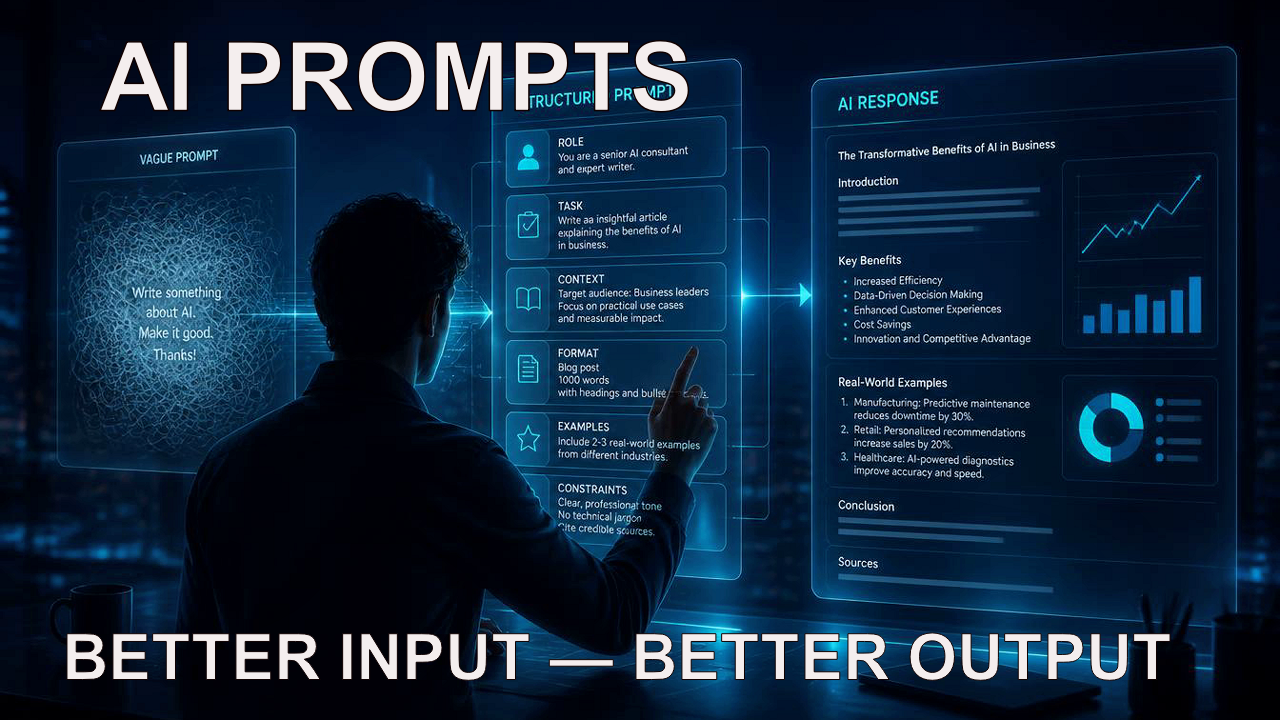
There are two types of people using AI.
“Write a post about artificial intelligence.”
Then gets a boring wall of text and concludes:
“You are an experienced technology copywriter. Create a short Telegram post explaining how AI can save time. The audience consists of people with no technical background. Use a friendly tone and light humor. Give me 3 headline options and keep the post under 1,500 characters.”
Suddenly, the answer becomes much more useful.
The difference isn't necessarily the AI model.
🤖 What Is a Prompt?
A prompt is simply an instruction you give to an AI model.
what to do → why → for whom → in what format → what to avoid.
“Write an 800-word article about coffee for a healthy-lifestyle blog. The audience is women aged 25–40. Explain the potential benefits and limitations in simple language. Avoid medical jargon and use a friendly tone.”
The second instruction gives the AI a much clearer target.
And that's the whole point of prompting.
🧩 The Formula for a Better Prompt
A strong prompt can contain several building blocks:
1️⃣ Role
Tell the AI who it should act as.
“You are an experienced SEO copywriter.”
“You are a Python teacher for beginners.”
A role helps establish the appropriate perspective, style and level of expertise.
“You are the greatest marketing genius who has ever lived…”
Specific expertise is much more useful than superhero credentials.
2️⃣ Task
Be precise about what you actually want.
“Create 5 Telegram post ideas for a fashion store.”
“Create 5 Telegram post ideas for a women's fashion store. The audience is women aged 25–40. The goal is to increase website visits. Give each idea a headline and a short description.”
Now the AI has a clear assignment.
3️⃣ Context
Context is one of the most underrated parts of prompting.
“Write a Telegram advertisement for a small skincare brand. The audience is women aged 25–40. The product is a moisturizing serum. Customers mainly struggle with dry skin. Keep the message natural and avoid aggressive sales language.”
Because the second prompt gives the model the situation.
4️⃣ Output Format
“Return the result as a table.”
“Create 3 options, each under 100 words.”
Yet people forget it all the time.
“Why did you write 2,000 words?”
Because you never said not to. 😁
5️⃣ Examples
If you want a specific style, show the AI an example.
“Here are two headline examples I like:
2. …
Create 10 new ones in a similar style without copying them.”
Examples can be extremely useful for:
You're not only explaining what you want.
You're showing the AI what good looks like.
6️⃣ Constraints
“Avoid an overly promotional tone.”
These small instructions can make a surprisingly big difference.
🧠 The Prompt Structure
ROLE → TASK → CONTEXT → FORMAT → EXAMPLES → CONSTRAINTS
Role: You are an experienced marketer.
Task: Create 5 headlines for a Telegram post.
Context: The channel covers AI tools. The audience consists of beginners.
Format: Each headline must be under 80 characters.
Examples: Use curiosity and a dynamic tone.
Constraints: No clichés, fake promises or aggressive clickbait.
Now you've given the AI an actual brief instead of:
🔄 What If the First Result Is Bad?
Don't immediately close the tab and blame AI. 😁
The first response is often just the beginning.
“Good start, but make the text less formal. Remove corporate language and add some humor.”
“Now shorten it by 30% while keeping the main ideas.”
“Create three stronger headline options.”
Prompt → result → review → refinement → better result.
And often the second or third version is dramatically better.
⚡ Don't Try to Create the Perfect Prompt Immediately
Another common mistake is spending 20 minutes writing a gigantic prompt before even testing it.
Start with a clear instruction.
AI isn't a vending machine with an:
It's more like a very fast assistant who needs a decent brief.
🎯 A Universal Prompt Template
Your task is to [WHAT NEEDS TO BE DONE].
[IMPORTANT INFORMATION ABOUT THE PROJECT,
AUDIENCE AND GOAL].
Target audience:
[WHO THIS IS FOR].
Output format:
[HOW THE RESULT SHOULD LOOK].
Examples:
[EXAMPLES OF THE DESIRED RESULT].
Constraints:
[WHAT THE AI SHOULD NOT DO].
Before giving the final answer,
check that the result follows all requirements.
You don't need every section for every request.
A simple question may need only one or two sentences.
But for complex work, this structure can save a lot of time.
🚀 The Most Important Rule
A good prompt isn't necessarily a long prompt.
If you want something specific — tell it exactly what you want.
🎁 Want ready-to-use AI materials?
Subscribe to the channel and head over to the Telegram bot.
You can choose one bonus or grab both:
🔥 “Universal Prompt Templates for Marketers”
💰 “8 Neural Networks for Making Money Online”
👉 Get your bonuses: t.me/invite_bot_EN_bot
Grab both — they'll be useful for working with AI and exploring ways to monetize AI tools. 🚀